Construction Workforce & Field Operations SaaS
FastBuild
A multi-market platform for construction sites, crews, attendance, tasks, payroll workflows, and daily reporting.
Overview
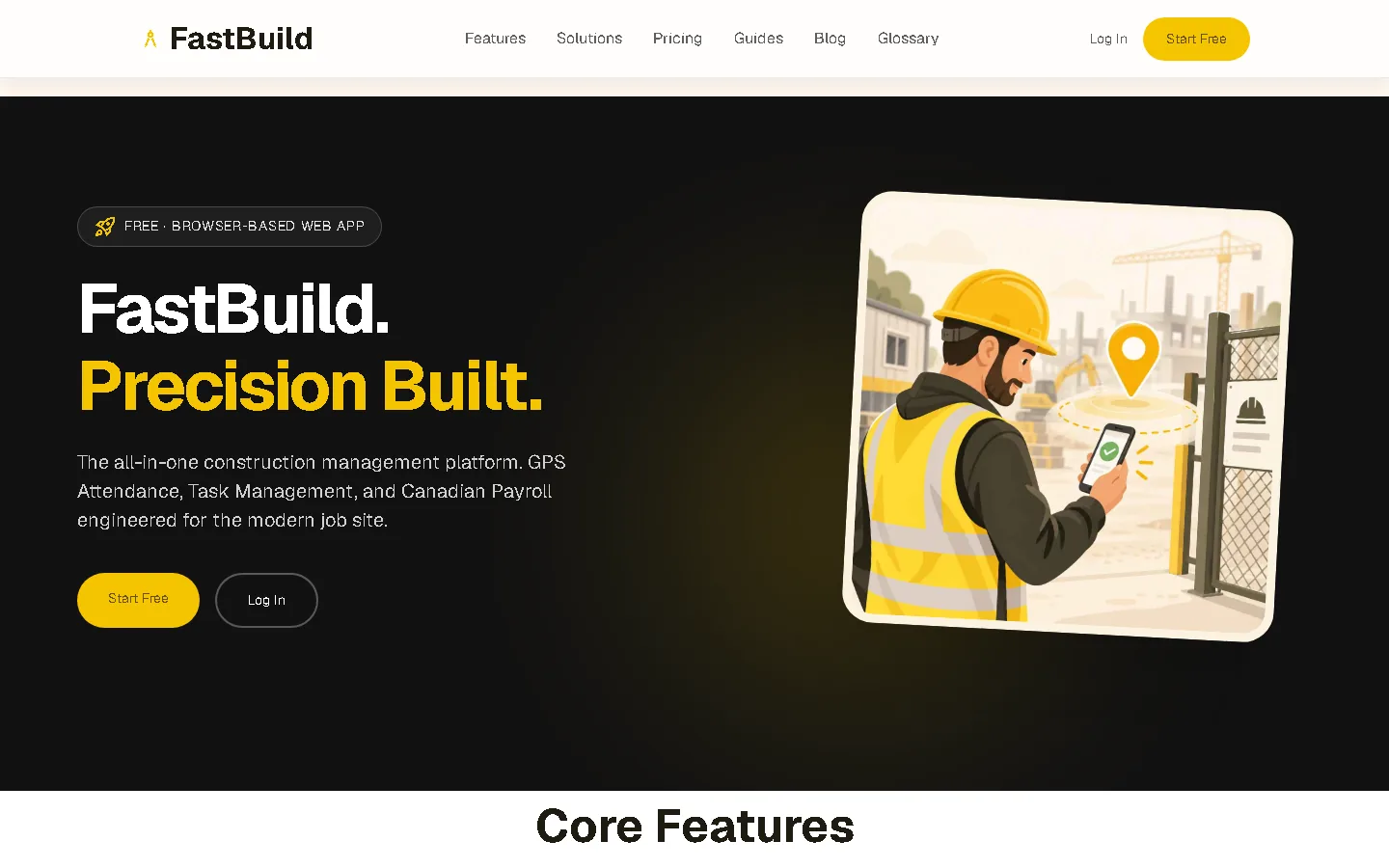
FastBuild is a browser-based workforce and field-operations platform for construction teams. It organizes site records, employees, GPS attendance, tasks, payroll workflows, notifications, and daily reporting.
The product has distinct Canadian and Iranian market configurations. Currency, tax logic, authentication, SMS delivery, billing, and legal copy belong to explicit market configuration rather than generic UI strings.
Origin and motivation
Construction work is distributed across sites, crews, shifts, and field conditions. Managers need reliable visibility into attendance, assigned work, daily activity, and workforce cost without forcing field teams into heavyweight desktop processes.
The problem
Site presence, tasks, payroll inputs, and daily reporting are often captured in disconnected tools. That makes workforce records hard to trust and harder to reconcile.
Who it is for
Construction companies, site supervisors, operations managers, and field crews that need a lightweight operational record across multiple sites.
Vision and objectives
A dependable operational layer that connects the jobsite to payroll, reporting, and management without overreaching into a full project-scheduling or cost-control suite.
Key capabilities
- Companies as tenants with membership roles and company context
- Construction sites, geofences, and site presence records
- Employee records, check-in and check-out work sessions, and attendance logs
- Tasks, comments, attachments, and daily activity records
- Payroll profiles, periods, entries, and market-specific tax rules
- Reports, notifications, subscription entitlements, and offline or mobile work
- English, French, German, and Persian localization in the repository
Engineering and architecture
The documented backend uses Django 5.1 and Django REST Framework, JWT authentication, shared-database and shared-schema tenancy, Redis for selected rate-limit, token, and queue functions, Celery, OpenAPI generation, and pluggable media storage.
The frontend is React and Vite. Mobile and offline code exists in the worktree, including Capacitor and Android artifacts. The inspected snapshot does not establish a complete store release or reliability envelope.
Difficult problems and solutions
Tenant-scoped records
Authorization is layered through company membership, role claims, request company resolution, feature checks, and tenant-aware selectors. A full isolation assessment is not established.
Market-specific payroll
Canadian and Iranian payroll rules, currencies, tax brackets, payment rails, and support models require traceable sources and effective dates. Localization is not only translation.
Field reliability
GPS and geofence behavior, offline synchronization, conflict resolution, and mobile distribution need market-aware validation under real field conditions.
Current status
FastBuild is a substantial production product. The dual-production acceptance report documents targeted backend and frontend checks and real-browser acceptance for selected owner-demo flows in both market applications.
That is scoped evidence, not proof that every module, tax calculation, payment path, or mobile mode passed end-to-end testing. Adoption, revenue, and commercial traction figures are not claimed.
Discuss FastBuild
If this work is relevant to your organization, start with the problem and the context.